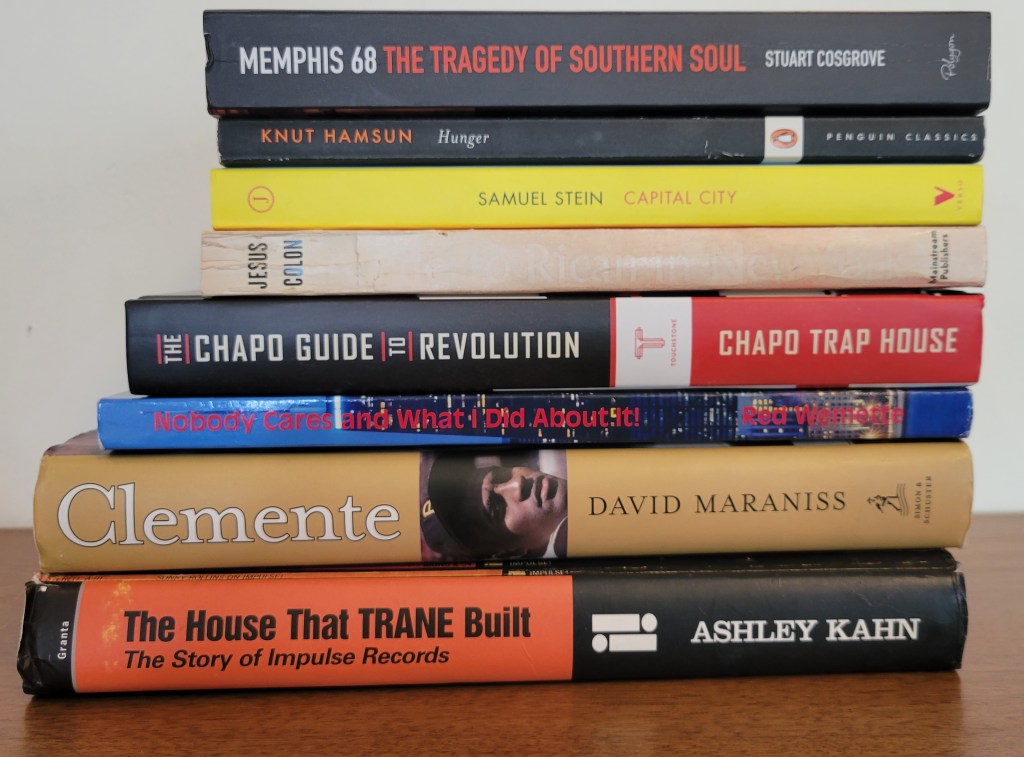
Originally appeared in The Coldest Issue # 1
“A Puerto Rican in New York and other sketches” by Jesus Colon (1961)
Originally published by what I believe was one of the Communist Party USA’s publishing houses, this is mostly a collection of columns by the author from The Daily Worker, the Communist Party USA’s newspaper, from the 1950s.
A lot of the columns are short accounts of his experience as a Puerto Rican in New York, or early working experience, or just simple reflections on otherwise mundane daily life.
While often talking about the gritty aspects of poverty, racism and exploitation, there is a lot of optimism here. I suppose to be a member of or associated with the Communist Party during the 1950s, one would have to be optimist.
“Cahokia: Ancient America’s Great City on the Mississippi” by Timothy R. Pauketat (2009)
A short book on the Cahokia civilization that existed in the St. Louis area from the 1000s-1300s. Cahokia has been a minor interest of mine ever since I learned about its existence a few years ago. I’ve since visited the site twice.
A lot of the history of the people and society that created Cahokia and lived there is not well known. Early European settlers and later American residents really didn’t give a shit about the area, and its large, obviously human-made mounds. A lot of the mounds and areas were bulldozed, destroyed, looted or paved over. Even some of the excavations and attempts to preserve the sites were last-ditch efforts by concerned archaeologists. Today there is a highway running through the site and a bit further away there is literally an ‘Indian Mounds Hotel’ built on land that contains human burials.
Even until recently, the prevailing wisdom among European-American historians had been that the indigenous never created or were incapable of creating a permanent, stable city-state north of Mexico. The studies and excavations of and at Cahokia shattered this myth.
I thought it was interesting that one of the first attempts to discover more about Cahokia was done by Preston Holder and Joyce Wike in the 1950s, a husband and wife who faced repercussions during the Second Red Scare. Although the book doesn’t really go into this, Holder was named by others in the House of Unamerican Activities Committee as being a Communist. He ended up self-censoring his published papers, losing funding and losing his job over all this.
Overall, a very informative and interesting book about a very important society that once existed in the Midwest.
“Capital City: Gentrification and the Real Estate State” by Samuel Stein (2019)
A short (202 pages) crash course on the different schools of urban planning and how they impact land use. The most valuable insight the book has is portraying housing, rent, land and property values as subject to blocs of interest, rather than being just the randomness of the market. For example, in mid-century US, real estate interests had to compete with manufacturing interests, and to a lesser extent, organized labor interests, when it came to urban planning policy. This kept land and rent cheap, as manufacturing executives want their employees to have affordable housing, so that they do not have to pay them more. As deindustrialization progressed, these manufacturing and labor interests became less influential and real estate interests became much more important until they became pretty much the sole dominant force. This partially explains the acceleration of gentrification, where once affordable, working class cities or neighborhoods transform into spaces for the more well off.
The book has some other good insights as well, such as how the current dominant ‘real estate state’ requires the simultaneous gentrification of one area with the defunding and degradation of another. It can then later take advantage of the degraded area. In this, it just sort of mirrors the cannibalistic nature of the broader capitalist system, which has to find areas to grow, however vaporous or socially negative, or die.
The last 1/3 of the book gets into Trump’s rise as a developer and how it represents the broader economic fortunes of real estate in late 20th Century/early 21st Century US.
“Chapo Guide to Revolution: A Manifesto Against Logic, Facts and Reason” by Chapo Trap House (2019)
Dripping with sarcasm, internet references, ridicule and scorn for the current state of things in the world. Sort of reads like a more skillful and knowledgeable version of well written leftist political zines I encountered as a teenager. Has some great (and grotesque) illustrations by Eli Valley as well.
It contains an onslaught of references to internet culture, media people, history and political figures that I assume would be hard to follow for some. I would say this is aimed at very online mid 20s-early 30s white millennial males who are overeducated and work meaningless jobs. So not for everyone…
“Clemente: The Passion and Grace of Baseball’s Last Hero” by David Maraniss (2006)
Generally a good book, describing the career of the first Puerto Rican, and first Latino, Major League Baseball superstar. The descriptions of what happened during specific games you can tell comes from an author who genuinely loves the game. It’s packed with information, with quick rattling off of stats.
Many references to Clemente today put him almost into sainthood. When he was playing that wasn’t the case. Although he was admired by fans and feared by opponents, his talents and mistakes were often attributed by sports media, managers and owners to what even we would now consider racist, condescending stereotypes. The book does not shy away from this shameful treatment of Clemente. It vividly describes how sports writers would quote Clemente phoenicaly, which angered him and sometimes eroded his self-confidence, as well as his relationship with the press. It describes his experience with legalized segregation as a minor league player in the 1950s South. It also dips into his relationship as a black Latino with African-American players and culture.
This is a great book as a primer on the player and person. The writing style is accessible and the pacing is quick, like a pop history book you would see walking into a Barnes & Noble.
However, the book has shortcomings. It is written by a white American, and while I’m not an advocate for the type of identity politics that suggests white people cannot try to tell the stories of people of color, I do feel the author’s identity influences what the book focuses on. The book would have been stronger by delving into the Puerto Rican experience of the time. Clemente himself may be the most popular and well known Puerto Rican in the world. The 1950s-early 1970s were an extremely important time for Puerto Ricans, both on the island and in the States. The experiences of that period continue to affect Puerto Ricans today in almost all aspects of our lives. The types of leaders we have, the types of politics we may adhere to, the communities we live in, etc. It’s hard not to contrast this book with Stuart Cosgrove’s series on soul music, which tells the story of different regional soul labels but includes much social history to put it into context.
“The House That Trane Built: The Story of Impulse Records” by Ashley Kahn (2006)
Good summary of the label, with emphasis on the producers and label heads who ran Impulse from the 1960s into the 1970s. Includes shorter, deeper dives on some select albums, as well as a useful discography.
Although most known for John Coltrane’s recordings and the more avant garde and free jazz styles that followed him, Impulse also revived the careers of a number of swing and bop artists, some who were in near obscurity before they signed to the label.
Great book to check out if you want a better understanding of Impulse’s catalog.
“Hunger” by Knut Hamsun (1890)
A somewhat disturbing story about a stubborn writer living in Oslo, Norway as he goes through starvation and the corresponding near insanity. At the time, this book was seen as new and quite shocking. In modern times, I think it is less shocking, but following the narrator’s bad decisions almost feels like an attack by the author on the reader.
Hamsun wrote a number of novels during his long life. He even won the Nobel Prize for literature. But his legacy has been somewhat tainted by the fact that he became a Nazi towards the end of his life. He even met with Hitler and Goebbels, and was arrested and fined by Norway at the end of World War II for treason.
“Memphis 68: The Tragedy of Southern Soul” by Stuart Cosgrove (2017)
The 2nd in a trilogy of books on soul music by the author, it was interesting reading this right before, during and after taking a trip to Memphis. Focusing on Stax Records, the Sanitation Workers strike and the assassination of MLK, Cosgrove really packs in a ton of information, people, events and places into this book. Cosgrove practices a form of musical scholarship that ties in socio-political events to put the music into context. This isn’t just a cut and dry listing of notable events and people who were around Stax or the Memphis soul scene. The author did a better job in this book, than ‘Detroit 67: The Year That Changed Soul’, which sometimes felt like he was tying together very separate things.
“Nobody Cares and What I Did About It! The Red Wemette Story of the Chicago Outfit” by Red Wemette & Ramon Clements (2016)
A collection of accounts by an adult store operator turned FBI informant and his encounters with various Chicago Outfit members and associates. The author played a roll in the federal case that crippled the Outfit in the early 2000s and played a roll in solving in infamous murder of three boys from the 1950s. Interesting by itself and more so since I recognize many of the Chicago and Northwest suburban locations.
Unfortunately it’s not very well written. It really does read like a self-published collection of random accounts. As a story, it doesn’t tie together. The author’s motivation to become an FBI informant isn’t really clear other than a vague sense of right and wrong, which doesn’t really seem like a good enough explanation. Also it sometimes feels like the author is glossing over some stuff that he may have been involved in that might make him look not as moral.
Overall, an interesting read on a slice of Chicagoland life that could have used a stronger editor and ghostwriter.

 The Coldest Zine